BUDAFOK CONCERT NIGHTS 3

Tonight, BDO will perform works that failed to gain public recognition in their time, and took several decades to eventually find their rightful place in music literature.

The first work to be performed is Edward Elgar’s only cello concerto. This is one of the lasts of Elgar’s major works, the basic melody of which is said to have been written down by the composer after a tonsillectomy, after days of suffering and pain. The Cello Concerto was later developed from this melody, but its première in 1919 was a failure caused by too few rehearsals and the conductor’s pique against it. A few decades later, the legendary cellist Jacqueline du Pré played the piece in concert, and succeeded in winning acclaim for it. In today’s concert, the young cello phenomenon, Danielle Akta will interpret the piece for us.

Our concert will then continue with Rachmaninoff’s Symphony No. 1. Although the Russian composer was exceptionally gifted in playing the piano, he had a keen interest in composing from a young age. His music teacher was strongly against his ambitions as a composer, and Rachmaninoff eventually left his teacher, so he could no longer hinder his development. His first opera, composed in 1892, won him great professional acclaim, which encouraged him to continue composing. A few years later, he wrote his Symphony No. 1, inspired by his enthusiasm for his love at the time. But the première of the work was a huge failure – allegedly due to an ill-prepared orchestra –, and Rachmaninoff could not get over it for several years. However, time has proved his talent, and it is now considered one of his finest works.

Tonight, Budafok Dohnányi Orchestra will be conducted by Yeruham Scharovsky from Israel.

BUDAFOK CONCERT NIGHTS 2

Tonight, our audience is kindly invited on a journey. During the pandemic, many people have not had the chance to travel to their favourite places or explore new landscapes to recharge their batteries. That is why BDO’s conductor, Gábor Werner has chosen for this evening a programme of works that in some way evoke the atmosphere of distant landscapes or the wonderful experience of travelling itself.

First, we will hear the 4th movement of Franz Schubert’s Symphony No. 3. Schubert is considered the last master of the Viennese Classical period and one of the first composers of Romanticism. Despite his short life, his oeuvre left behind is very rich, and the piece we are listening to tonight was basically written in the space of only 10 days. The complete work was never performed during his lifetime, and the full symphony was not premièred until 1881. Previously, in 1860, the fourth movement was performed in Vienna, and it is this movement that will be heard at today’s concert, too. It is a joyful finale to the Symphony No. 3 that, with its serene mood and its style is reminiscent of Rossini’s tarantella rhythms, evoking the sunny landscapes of Sicily in the listeners’ minds.

The next piece to accompany us on our journey to the different cities or landscapes around the world is Péter Wolf’s violin concerto. The composer wrote this work at the request of Kristóf Baráti and the Budapest Strings Chamber Orchestra, and later composed a complete symphonic orchestral version in six movements, in which six landscapes or cities are visited through music.

The cheerful journey begins with a dance in the first movement, named after the French port city of Le Havre, which captures the excitement of setting off and setting sail. The next stop takes us to the Latin, Spanish landscapes of Andalusia, and from there we fly to Liverpool, the city of the Beatles. Our journey here takes a sudden turn towards Jerusalem, with its wealth of history and culture, in the hope of finding peace, then we visit the countryside of Bihar (a county in Northwestern Romania, with significant Hungarian population and history – the tr.), and especially the people who live there, before our final stop in Dublin, where we sit in a pub and enjoy Irish music and Irish pub grub.

After Péter Wolf’s far-reaching journey, the next stop is the Spanish countryside, with its Latin atmosphere, delivered to us by Hugo Wolf’s Der Corregidor Suite. Hugo Wolf was an Austrian composer who lived in the second half of the 1800s and was known mainly for his songs. In 1895, he wrote a comic opera entitled Der Corregidor, with a libretto based on Pedro Antonio de Alarcón y Ariza’s story, The Triangular Hat. Tonight, BDO will perform the suite version. The story features some real Mediterranean complications: a miller who thinks his wife is having an affair with the village magistrate causes a commotion. All this is set against the backdrop of the Andalusian countryside and the everyday life of Andalusian villages.

Finally we return to Italy, and with Tchaikovsky’s Italian Capriccio we can once again enjoy the soul-warming experience of sunny landscapes, listen to emotional serenades, street mandolin music, and dance the tarantella again, while enjoying the catchy motifs of Italian songs.

We invite our audience to come and enjoy this journey, sit back with your eyes closed and smell the sea, the sunshine and enjoy the wonderful world of new and perhaps unknown landscapes

BUDAFOK CONCERT NIGHTS 1

Child Prodigies’ Concert

For this season’s first concert in Budafok, Gábor Hollerung has chosen works by 3 composers who were considered child prodigies in their time.

The first piece to be performed is Georg Philipp Telemann’s Burlesque de Quixotte Suite. This German composer had no musical education, but his early talent was continuously supported by his teachers, despite parental forbidding. By the age of ten he was already playing several musical instruments and at twelve he wrote his first opera. To this day he is considered one of the most prolific composers, having written more than 3,000 works. Tonight, our audience will be able to listen to his Burlesque de Quixotte Suite, written in the last year of his life. The work is based on the novel Don Quixote de la Mancha by Cervantes, whose protagonist, imagining himself a knight errant, sets off in search of adventure. The word burlesque means mockery, joke, farce, and Telemann gives this title to his work because it refers to the situation comedy of a character who endows prose reality with the ideals of the world of knights. The work for string orchestra begins with a French overture, followed by six further movements in which we meet Dulcinea, Sancho Panza and the Windmills.

The next prodigy of the evening is Erich Wolfgang Korngold. Born in Brno, he was playing piano four hands with his father by the age of four, composing by the age of seven and premiering his first works at the age of thirteen. His musical career took a major turn when the world-famous American director Max Reinhardt asked him to write the score for his film A Midsummer Night’s Dream, which was released in 1935. Korngold performed this task so well that he went on to compose incidental music for several other films, creating a new genre: symphonic film music. He went on to receive three Oscar nominations and two Academy Awards in this genre. Tonight’s suite entitled Much Ado About Nothing is an early work by the composer, written in 1918 for the Schlosstheater company in Schönbrunn as incidental music for the Shakespeare play. It consists of four movements and an overture.

Our concert will conclude with Camille Saint-Saëns’ Symphony No. II. Born in 1835, the French composer was also considered a child prodigy. He was barely able to walk and talk when he learned to play the piano, had already composed his first piano piece at the age of 3, started studying composition at 7, performed as a pianist at 11 and was accepted at the Paris Conservatoire at 13, where he eventually graduated in music. His Symphony No.2, which we will perform tonight, was composed in 1859 and premièred in Leipzig in the same year. It was premièred in Paris a year later, conducted by Jules Pasdeloup, to whom Saint-Saëns himself dedicated the symphony.  After a brief introduction, the symphony opens with a fugue, followed by a short adagio movement, then a rather unusual scherzo, and finally a tarantella

MUSIC PLUS SERIES – The Song of the Earth

From Haydn‘s rich symphonic repertoire, tonight we will perform Symphony No. 99. Haydn, the master of the Viennese Classicism, is rightly known as the father of the symphony, having composed more than 100 symphonies. It was also under his influence that the symphony, originally in three movements, was transformed into a four-movement musical piece with the introduction of a minuet before the final movement. Symphony No. 99 is one of the so-called London symphonies, of which the composer wrote twelve during his travels in London between 1791 and 1795.

He was nearly 60 years old when his first conductor’s post in the court orchestra of the Eszterházy princes ended with the death of Miklós Eszterházy in 1790. In order to make a living, he accepted an invitation from Johann Peter Salomon to go to London. Salomon commissioned an opera, half a dozen symphonies and other works from the composer. Haydn delivered the commission and, although his opera Orpheus and Eurydice was not performed in his lifetime, his symphonies were a huge success and he became very popular in London. He returned from London after two years, but in preparation for his next journey, he wrote his Symphony No. 99 (in E-flat major) in 1793. It was premiered in London the following year. When Haydn wrote the symphony, he was an old fox, but he still brought some innovations into his work. Among other things, he introduced the clarinet for the first time, probably thanks to the influence of Mozart, who was much younger than Haydn and had died by then. The piece opens with a first movement rich in tonal variations, followed by an adagio movement in the sonata form, and a lively finale after the minuet.

Mahler composed The Song of the Earth at one of the most critical times in his life: he had just lost a daughter, his health was deteriorating, his heart condition was discovered and his marriage got in a crisis. To lift his gloomy mood, an acquaintance gave him a book of poems by the German philosopher and Germanist Hans Bethge, which contains transcriptions of 8th century Chinese poems. Mahler was so moved by the wisdom and melancholy tone of the poems’ content that he decided to choose six texts to compose music to them. That’s how, in 1908, this song cycle was born, in which we find a drinking song, a song about the autumn sunshine, youth, beauty, spring, in other words, everything that brings joy but also suffering because of its transience, and the cycle ends with the Farewell Song, which lifts us to transcendental heights.

ZENEPLUSZ BÉRLET 3. SMETANA: AZ ELADOTT MENYASSZONY – SZCENÍROZOTT ELŐADÁS

Of all Smetana‘s operas, The Bartered Bride (Prodaná Nevesta) is the most important in the Czech national classical canon. The use of the term “bartered” (in many translations – but the Hungarian – of the title) further emphasises the comic, folk tale like character of Smetana’s opera. The village love story is very simple: Mařenka loves Jeník, but her parents intend her to marry the local rich man Micha’s other son, Vasek. For a huge sum of money Jeník agrees with the matchmaker to give up the matrimony he planned with Mařenka, but on the condition that Mařenka marries Micha’s eldest son. Apart from Jenik, no one in the village knows that he himself is Micha’s lost son. So the bargain is made, which causes many-many complications and love struggles. But in the end, as in Molière’s comedies, everything falls into place with an unexpected twist. All’s well that ends well: the people of the village are also pleased with the outcome which they celebrate by singing and dancing merrily. Smetana was so enchanted by the fable like story that he composed a beautiful prelude: the opera’s overture was later performed as a concert piece in its own right.

MUSIC PLUS SERIES – 2 SERGEI NAKARIAKOV

World-renowned trumpet player Sergei Nakarjakov burst onto the international music scene in the early 1990s. He has played with some of the greatest conductors, including Sir Neville Marriner, Kent Nagano, Mikhail Pletnyov, Sakari Oramo, Jaap van Zweden, Valery Gergiev, Vladimir Spivakov, Christoph Eschenbach, Vladimir Ashkenazy and Jiří Bělohlávek. He has recorded more than fifteen CDs for the most important record companies. He performs in the most important concert halls, both as a soloist in concerts and as a chamber musician. He is regularly accompanied by Belgian piano player Maria Meerovitch or his sister Vera Ohotnikova.

The orchestra will perform Amilcare Ponchielli’s Trumpet Concerto, a magnificent concerto from the Italian Romantic period, and The Carnival of Venice, a series of variations on a Neapolitan folk song by Joseph Jean-Baptiste Laurent Arban, one of the most important French trumpet virtuosos of the period.

MUSICPLUS SERIES 1 – MOZART: DON GIOVANNI

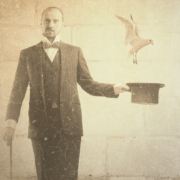
Mozart’s most mysterious work has been both enchanting and puzzling audiences for more than 200 years. Director András Hábetler has put a twist on traditional productions of the piece by setting it in the decadent world of the 1920s, with legerdemain and magic tricks making Mozart’s best-known opera even more riveting.

Although it was 233 years ago when Wolfgang Amadeus Mozart premièred his two-act opera Don Giovanni in Prague, the Don Juan theme itself has been around for a good four centuries, and dozens of writers have attempted to create their own treatments of it. The most lasting and outstanding one of them all, however, remains Lorenzo Da Ponte’s libretto combined with the music of Mozart. Even though the original plot is already full of unimaginably unexpected turns, András Hábetler, the director of this fully staged production, has given it an additional twist, setting the opera in the decadent world of the 1920s. And in case anyone craves more than the abundant unscrupulous deeds, lies and tricks of the world of Don Giovanni, there will also be true legerdemain in the form of magic tricks taught by Anikó Ungár to add colour to the production. Conducting the outstanding soloists and the Dohnányi Orchestra Budafok will be Guido Mancusi.

MEGÉRTHETŐ ZENE 5. KOLLETKÍV ZENEI EMLÉKEZET

MEGÉRTHETŐ ZENE 4. HANGULATOK

COMPREHENSIBLE MUSIC 3: HISTORY

Respighi’s work is a typical example of the pictorial compositional technique. In each movement of the work, the composer associates an image, a mood or a historical scene with a characteristic place in Rome. In the first movement, the spacious gardens of Villa Borghese, one of Rome’s most popular parks, provide the backdrop for the musical depiction of a big group of children playing, teasing each other and creating a noisy confusion.

The second movement evokes the atmosphere of the Fantastic Symphony and Pictures at an Exhibition. The mystery of the catacombs is then revealed through evoking Gregorian chants.

In the third movement, the pines of the Gianicolo Hill evoke the atmosphere of a sultry night scene, with the song of the nightingale at the end of the scene heralding the arrival of dawn.

In the last movement, the image of a historical memory is outlined as the victorious and glorious Roman army marches towards the Capitoline Hill.