CHRISTMAS ACTUALLY – a symphonic concert show

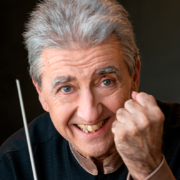
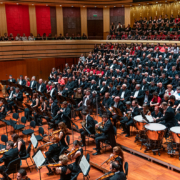
The best ever Christmas present for the whole family: CHRISTMAS ACTUALLY – symphonic concert show. A spectacular celebration by Budafok Dohnányi Orchestra, with popular Christmas tunes from the worlds of classical music, pop and jazz, with choir singing, dance, aerialists, glockenspiel and outstanding soloists.  Conducted by: Gábor Hollerung

Christmas Actually – on 28th December at MVM Dome!

CINEMUSIC – family-friendly cinemusic concert – not just for families

Budafok Dohnányi Orchestra‘s iconic CINEMUSIC concert with excellent film music, cinematic imagery, Gábor Hollerung‘s delightful introductions and suggestive conducting, offers a fully entertaining evening concert at Müpa Budapest. The orchestra will once again present a selection from the best hits of the film music repertoire, including music from the latest blockbusters as well as some evergreens.

The concert is recommended for children over 8.

Join our BDO Film Club to be the first to know about our upcoming film music concerts: https://www.facebook.com/groups/435512760983959


CINEMUSIC

Budafok Dohnányi Orchestra‘s iconic CINEMUSIC concert with excellent film music, cinematic imagery, Gábor Hollerung‘s delightful introductions and suggestive conducting, offers a fully entertaining evening concert at Müpa Budapest. The orchestra will once again present a selection from the best hits of the film music repertoire, including music from the latest blockbusters as well as some evergreens.

The concert is recommended for children over 8.

Join our BDO Film Club to be the first to know about our upcoming film music concerts: https://www.facebook.com/groups/435512760983959

Comprehensible Music / Zemplén Festival

There is a concert form with Gábor Hollerung’s unique-styled, suggestive and captivating explanations that’s considered the trademark of Budafok Dohnányi Orchestra. It’s a production that year after year has been a great success among the visitors of the Zemplén Festival, entitled Comprehensible Music. This time, the special atmosphere concert aims to bring Sergei Rachmaninoff’s Piano Concerto No. 2 closer to the audience.

The soloist of the performance will be János Balázs, Kossuth and Liszt Ferenc Prize-winning pianist, founder and artistic director of the György Cziffra Festival, associate university professor and distinguished artist.

Free entrance

Viennese Classics / Zemplén Festival

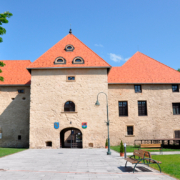
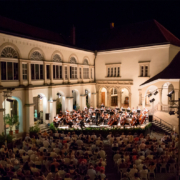
Two years ago we started the summer open-air concerts in the courtyard of the Rákóczi Castle in Szerencs, with the intention of creating a tradition. This year, the concert will be conducted by Budafok Dohnányi Orchestra’s principal guest conductor, the Austrian Guido Mancusi, who has compiled a programme of Viennese Classicism and early Romanticism.

The first piece is the Symphony No. 60, also known as “Il Distratto” (“The Absent-Minded Gentleman”). Haydn’s 100 or so symphonies show a great variety of forms, but No. 60 in C major, with its six movements, its many special structures and many musical quotations, is quite exceptional even within this vast repertoire. Although the work became widely known as a symphony in Haydn’s time, it was originally written as incidental music for the German translation of Jean-François Regnard’s stage play Le distrait (Der Zerstreute). The Italian term “Il Distratto” often appears on contemporary manuscript copies of the work, so it is clear that the composer was recycling the incidental music he had written for the play in the form of a symphony. (Source: Magyar Zene /Hungarian Music/, Balázs Mikusi: Haydn Il Distratto kísérőzenéje és a “színházi szimfónia” esztétikája /Haydn’s Il Distratto incidental music and the aesthetics of the “theatrical symphony”/ – Study)

Following this, a piano concerto will be performed, the soloist of which is Fülöp Ránki, who, despite his young age, is a renowned and popular Hungarian composer. Son of the renowned pianist couple Edit Klukon and Dezső Ránki, he has been performing from a very young age and is now a teacher at the Liszt Academy of Music, Budapest.

The work in question was written by Beethoven between 1796-1797 and premièred in Prague in 1798; the piano solo was of course played by the composer himself. He dedicated the concerto to his patron, the Princess Odescalchi-Keglevich. Although the piece has become known as his first piano concerto, it is in fact the composer’s third work in that genre. A few years earlier, in Bonn, Beethoven had already tried his hand at it, but only the piano solo (Piano Concerto No. 0) of this never published concerto in E flat major survives. However, the Piano Concerto in B-flat major No. 2, listed under Op. 19, was, by Beethoven’s own statement, written between 1794-95, so chronologically speaking it was his first piano concerto. (Text based on wikiwand.com article.)

After the intermission, the last piece to be performed is by Schubert: his Symphony No. 6. Its public première – since his ‘great’ Symphony in C major proved too difficult to perform – took place a month after the composer’s death at a concert of the Society of Friends of Music in Vienna in December 1828.

In this work of Schubert’s there is less influence by Mozart and Beethoven to be detected: it follows the style of the Rossini overtures that were fashionable at the time. The ‘little’ Symphony in C major is an easily liveable piece: Italianate verve, joyful spirit and light-hearted playfulness prevail in it. At times, however, it nonetheless anticipates some of the intrepid Schubertian tone that characterises so many later compositions, including the ‘great’ Symphony in C major. (Source: Marianne Pándi: Hangversenykalauz /Concert Guide/)

Opening Concert / Zemplén Festival

As is traditional by now, the thirty-first series of events of the Zemplén Festival will start with a concert by Budafok Dohnányi Orchestra. To be performed are the works of two anniversary composers, whose works themselves were originally composed for an anniversary, respectively.

Felix Mendelssohn-Bartholdy died 175 years ago, in the 38th year of his life. He was not yet 21 years old when, in December 1829, he began to think about writing what he called a church symphony for the 300th anniversary of Protestantism.

This anniversary was the jubilee of the Confessio Augustana, or the Augustan Confession, the most important collection of Protestant doctrines signed at the Imperial Diet (Assembly) of Augsburg and officially presented and read out on 25 June 1530. The Augustan Confession was composed and written on the basis of Luther’s dogmas and the guidelines of other Saxon theologians by Melanchton and approved by Luther.

Mendelssohn had not actually been commissioned to write such a celebratory work, but he chose this way to prove his inner, personal dedication. He had intended to have it ready by January 1830, but his poor health prevented him from doing so; and to top it all, he also contracted measles from his sister. So not only was the score not ready in January, but he was unable to make the four-month tour with the symphony that he had planned to start in March. The work was finally completed in May, presumably too late to be appreciated and accepted by the Augsburg Committee organising the anniversary celebrations. So instead of Mendelssohn’s symphony, Eduard Grell’s austere piece for male choir was performed on 25 June 1830. Mendelssohn was not to enjoy the success of this work later either, as in 1832 an orchestra in Paris refused to perform it, while the London performance was cancelled by himself. On his return to Berlin he revised it, and only then was it performed for the first time. In 1838, however, he looked back at it as a ‘youthful composition’ and never had it performed again. It was not played again until 1868, more than 20 years after his death.

Mendelssohn wrote “D major” on the original score of the “Reformation” symphony, but he composed only the introduction in this key, and the main theme of the first movement is already in D minor. Later, on at least one occasion, the composer himself referred to his symphony as D minor, which he wrote as his second but listed as No.5.

The reason for the D major / D minor dilemma arising is probably to be found in the first movement: at the end of the introduction that lasts just over three minutes, the so-called “Dresden Amen” is played, a tone sequence composed by J.G. Neumann in the 18th century for use in the royal chapel in Dresden, but which quickly became popular in both Catholic and Lutheran services in Saxony. The Dresden Amen is a gradually ascending six-note melody, in which the transition from major to minor is created by the final note, thus achieving the impressive musical effect worthy of an ‘Amen’.

The very beginning of the work is of musical historical significance: Mendelssohn’s use of the motif melody from the 4th movement of Mozart’s “Jupiter” symphony is a reference to Gregorian chant and Catholicism. It is no coincidence that these harmonies also bring Palestrina to mind, however, Mendelssohn culminates this brief historical introduction with the “Dresden Amen”, which is played twice after the fanfares, and from there he continues with the majestic melody in D minor.

The other significant musical reference in the work is the leitmotif of the 4th movement: the chorale melody “Ein feste Burg ist unser Gott” / “A mighty fortress is our God”, composed by Martin Luther, which is first played on the flute and then taken up and elaborately unfolded by the other instruments.

After the intermission, the emblematic composition of Zoltán Kodály, born 140 years ago, will be performed. Psalmus Hungaricus was written in November 1923 for the 50th anniversary of the unification of Pest, Buda and Óbuda (to become what is known as the city of Budapest today – the tr.). We are barely three years after the Treaty of Trianon (prepared at the Paris Peace Conference in 1920, the treaty ended the 1st world war officially and brought about massive territorial and population losses for Hungary – the tr.), yet somehow we are trying to celebrate the creation of the capital through the unification of the three cities.

The international success of his composition meant a comeback in Kodály’s personal life, as he had taken part in the work of the music directorate during the Republic of Councils (in 1919 – the tr.), for which he was disciplined after the fall of the communist party, forbidden to teach for years and forced to remain silent.

Psalmus Hungaricus is a musical dramatisation of the 16th century text of Psalm 55 in the Book of Psalms, translated by Mihály Vég of Kecskemét.

You can read a detailed description of this work by Gábor Hollerung here: https://hollerung.hu/the-answered-question/

During the intermission there will be a wine tasting session by Grand Tokaj Zrt., the Official Wine Supplier of the Zemplén Festival.

Gustav Mahler Music Weeks 2022

From Haydn‘s rich symphonic repertoire, tonight we will perform Symphony No. 99. Haydn, the master of the Viennese Classicism, is rightly known as the father of the symphony, having composed more than 100 symphonies. It was also under his influence that the symphony, originally in three movements, was transformed into a four-movement musical piece with the introduction of a minuet before the final movement. Symphony No. 99 is one of the so-called London symphonies, of which the composer wrote twelve during his travels in London between 1791 and 1795.

He was nearly 60 years old when his first conductor’s post in the court orchestra of the Eszterházy princes ended with the death of Miklós Eszterházy in 1790. In order to make a living, he accepted an invitation from Johann Peter Salomon to go to London. Salomon commissioned an opera, half a dozen symphonies and other works from the composer. Haydn delivered the commission and, although his opera Orpheus and Eurydice was not performed in his lifetime, his symphonies were a huge success and he became very popular in London. He returned from London after two years, but in preparation for his next journey, he wrote his Symphony No. 99 (in E-flat major) in 1793. It was premiered in London the following year. When Haydn wrote the symphony, he was an old fox, but he still brought some innovations into his work. Among other things, he introduced the clarinet for the first time, probably thanks to the influence of Mozart, who was much younger than Haydn and had died by then. The piece opens with a first movement rich in tonal variations, followed by an adagio movement in the sonata form, and a lively finale after the minuet.

Mahler composed The Song of the Earth at one of the most critical times in his life: he had just lost a daughter, his health was deteriorating, his heart condition was discovered and his marriage got in a crisis. To lift his gloomy mood, an acquaintance gave him a book of poems by the German philosopher and Germanist Hans Bethge, which contains transcriptions of 8th century Chinese poems. Mahler was so moved by the wisdom and melancholy tone of the poems’ content that he decided to choose six texts to compose music to them. That’s how, in 1908, this song cycle was born, in which we find a drinking song, a song about the autumn sunshine, youth, beauty, spring, in other words, everything that brings joy but also suffering because of its transience, and the cycle ends with the Farewell Song, which lifts us to transcendental heights.

MOZART: REQUIEM / HÄNDEL: MESSIAH – HALLELUJAH

The Budapest International Choir Festival will take place for the fourth time between 1 and 3 July 2022. At the closing concert of the festival, the Let the Nation Sing programme founded by Gábor Hollerung will be expanded to an international format, with a choir of international choral singers performing two of the most popular works of choral literature, or, more precisely, excerpts from them.

INTERNATIONAL CHORAL GALA / ORFF: CARMINA BURANA – PART I

The Budapest International Choir Festival will take place for the fourth time between 1 and 3 July 2022. The opening concert of the festival, the International Choral Gala will offer the audience an experience of the many faces of choral music, the colourful culture and diverse repertoire of choirs, with the participation of the best ensembles of the choral world.

The first part of the Opening Concert will feature a capella performances by 5 choirs (Croatian, Slovakian, Polish, Israeli and Hungarian). The second half of the concert will feature Part I of Orff’s Carmina Burana, a composition about the turning of fortune, the awakening of spring and the self-forgetting, happy play of young people in the spring meadows. The transcript to be performed was written for 2 pianos and percussions.

HAYDN: THE CREATION

Haydn‘s travels in England introduced him to the local musical scene, and he was present in the performances of several Handel works, including oratorios. He was fascinated by Handel’s oratorios and, although he had written a few before, the use of the chorus, the orchestra, the choir and the solo voice to dramatic effect was a new experience for him. Peter Salomon, the organiser of Haydn’s first trip to England, showed him a text by the poet Thomas Linley (1733-1795) entitled The Creation of the World, based on John Milton’s Paradise Lost. Handel had already been given this text, but he found it too meticulous and detailed, so he ignored it.
Haydn, on the other hand, was captivated by the detailed natural imagery and took it back to Vienna with him. There, Baron Gottfried van Swieten, diplomat, literary man and a central figure in Viennese musical life, translated it into German and added a few psalm quotations. Its first performance outside Vienna took place on 8 March 1800 in Buda, conducted by Haydn, as part of the wedding and birthday celebrations of Palatine Joseph and Alexandra Pavlovna Romanova. The play was so popular in Hungary that in 1820 a street was named after it – mistakenly translated as “Alkotás” (meaning “Artwork”) in Budapest.

The musical work consists of 34 movements in all and it employs three vocal soloists (soprano, tenor and bass) and a full mixed choir. The first part is about the first four days of creation, the second about the fifth and sixth days, while the third part is about the first human couple, Adam and Eve. This evening Budafok Dohnányi Orchestra will be conducted by the orchestra’s principal guest conductor, Guido Mancusi.