BUDAFOKI HANGVERSENYESTÉK 22-23/2

The first piece of the evening will be by an Argentinean-born composer, Alberto Ginastera, performed by Budafok Dohnányi Orchestra. Ginastera is one of the most important South American composers of the 20th century. Born to a Catalan father and an Italian mother, he studied music in Buenos Aires and later he himself taught and trained some renowned composers. The suite to be performed this evening is Ginastera’s second ballet, commissioned by the American Ballet Caravan in 1941. The title of the work – Estancia – means vast estate, and the work itself was conceived as a 5-scene piece about rural life in Argentina. For various reasons, the ballet performance was not staged until 11 years after the work had been written, in 1952, but it was premièred as an orchestral work in 1943, after the composer had extracted a few dances from the work to create a suite version. Thus, the piece performed this evening consists of 4 movements, including a lively dance with Argentine folk music motifs and an emotional, lyrical movement.

Honegger wrote a total of three concertos, one of which is his Cello Concerto, written in 1929. This work is one of the most joyful and entertaining of the composer’s oeuvre, yet it is largely overlooked in concert halls. The work is characterised by its transparency and simplicity complete with jazz elements; and the composer’s respect for Beethoven and Bach is evident in the tools for music form, the traditional structure and the use of the counterpoint. The general problem of cello concertos is to achieve a balance between the solo instrument and the orchestra. Honegger brilliantly resolves this balance in a way that creates a dialogue rather than a debate between the two sides, and does not wrestle with larger philosophical issues as he does in other works. In today’s concert, the solo is played by the young Spanish cellist Luis Aracama Alonso, a graduate of the Reina Sofia School of Music in Madrid, who regularly improves his skills in master classes with great artists such as Márta Gulyás, Gautier Capuçon and Enrico Dindo. Hungarian audiences have already had the chance to meet him in this year’s Symphonic Discoveries series at Müpa Budapest.

The final piece of the evening is Rimsky-Korsakov‘s popular work Scheherazade. The composer wrote and premièred this work in 1888, which he called a symphonic suite. The work is inspired by a well-known collection of Arabic tales in which, night after night, Scheherazade keeps the Sultan’s attention and his heart captivated with a new story. Each of the four movements of Rimsky-Korsakov’s work is based on a story: the first is about Sindbad the Sailor, the second about the pranks of Prince Kalandar, the third about the love between the young prince and the young princess, and the fourth about the whirl of a Baghdad festival and a ship run aground on the stormy sea.


Budafok Concert Nights Series 22/23/1

The Overture to Manfred is an excerpt from Schumann’s dramatic poem with music, as the composer himself called his work, written to accompany Byron’s drama of the same title. Byron wrote the poem Manfred in 1816 and rewrote the third act the following year. According to Byron’s description, it is a metaphysical drama in which supernatural beings and elements are depicted that also serve as the backdrop for a profound spiritual drama. The protagonist is consumed with guilt over the death of his lover and seeks forgiveness. At the end of the work, death releases him from his spiritual torment. The dramatic story of the protagonist makes it easy to think of a biographical parallel, since Byron began writing this work after he was forced to leave England. The reason for his departure was his alleged love affair with his half-sister, and he left his country to avoid scandal. Schumann discovered the work in 1848, at a time when he was tortured by hallucinations, and perhaps because of the parallels he felt between the protagonist’s mental suffering and his own, he set about composing the music with great dedication. The Overture is a piece of music that is usually performed at concerts, as it is a dramatic, passionate piece of music that reflects the turbulent state of mind of Byron’s protagonist. Schumann’s work was first performed in 1852 in Weimar, conducted by Ferenc Liszt.

Wagner’s Wesendonck Lieder (“Wesendonck Songs”) was also inspired by a forbidden love. Mathilde Wesendonck was not only the muse but also the poet of the songs. In 1858, Wagner was a guest at the villa of his patron Otto Wesendonck near Zurich, where he met the host’s wife Mathilde. She had a great influence on Wagner, and it is said that they developed a secret love affair, and that it was by Mathilde’s influence that Wagner began to set Tristan and Isolde to music. The Wesendonck songs could only acquire this title after the woman’s death, before which they were entitled Five Poems for a Female Voice. The original version was with piano accompaniment, but later one of Wagner’s conductors, Felix Motti, wrote a version for orchestra, which follows the harmonies of Tristan and Isolde.

The final work of the evening is Johannes Brahms’ Symphony No. 3, composed in 1883 and first performed in Vienna. Brahms stuck to the traditional form and wrote his work in four movements following the classical form. The first and last movements are in the sonata form, the second has the features of variation, and the third is in the trio form, a three-part composition.

The work is usually described as heroic in character, but it is also considered to be a mysterious piece of music. The main key of the symphony is F major, but it is so often shaded into a minor key that it casts a gloomy shadow over the character of the composition as a whole. In addition, all the movements of the symphony end softly, which emphasises the lyrical character, and is a unique solution in the Romantic period.

Kálmán Oláh: The Michel Legrand Songbook

The late Oscar and Grammy Award-winning French composer Michel Legrand would be turning 90 this year. There is no doubt about his place as one of the most significant composers of film music and musicals. However, his work was not limited to the cinema, as his compositions were given treatments by countless musicians in different genres. Naturally, major figures in the jazz scene were no exception to this. It would also be impossible to list how many artists from the world of improvisational music used Legrand songs as starting points. These included Miles Davis, Oscar Peterson and Bill Evans, just to mention a few.

This time, Hungarian jazz great Kálmán Oláh has elected to show what Legrand’s songs mean to him with adaptations of eleven of the French master’s melodies. As we have become accustomed to seeing, it is not “merely” his impressive skills as a pianist that Oláh demonstrates to the audience: he is also known for his expertly and sensitively constructed new arrangements. He has now conceived of a unique sound for singers from two different genres: this meeting between Erika Miklósa and Vera Tóth promises to be a veritable musical treat. The leader of the jazz band is the world-famous drummer Elemér Balázs, and joining them to make the Michael Legrand Songbook truly singular will be the Budafok Dohnanyi Orchestra. The Umbrellas of Cherbourg, Yentl, The Thomas Crown Affair, and we could list many more. All of these titles sound familiar, don’t they? We loved both the films and their music. We often find one or another of these tunes coming to mind and start humming it on the bus, on the tram, or while walking around. Now we can hear these.

Presented by: Jewish Art Days, Brice Management

TEMESI BERCI – SYMPOSIUM 40 DOHNÁNYI

Temesi Berci negyedik szólólemezének bemutatója,  melyen instrumentális dalok mellett énekes kompozíciók is szerepelnek. A dalokat Werner Gábor, zenekarunk karmestere hangszerelte, és a lemezt 2021-ben Fonogram-díjjal jutalmazták.

ROMANTIC GIANTS – BRAHMS: ALTO RHAPSODY; CANTATA RINALDO

The second performance of Honvéd Male Choir’s Spring 2022 season will focus on Goethe‘s poetry. Both the lyrics of Brahms‘s Alto Rhapsody and Rinaldo were written by Goethe.

The text of the Alto Rhapsody consists of verses 5-7 of the poem entitled “Winter Journey in the Harz” (Harzreise im Winter). Its painful tone reflects the emotional world of Romanticism. Brahms wished to marry Julie Schumann, the daughter of Robert Schumann and Clara Schumann, but the girl’s parents preferred to marry her to an Italian count instead. The extremely depressed general atmosphere of the Altro Rhapsody is due to the composer’s state of great disappointment and despair in which he wrote it; and then gave it to Clara Schumann as a wedding present on her wedding day.

Rinaldo is also a direct evocation of a romantic soul tormented by doubts of love, based on the story of Rinaldo in Torquato Tasso’s Jerusalem Delivered. The lyrics of the cantata is based is Goethe’s only work written specifically as a libretto for the great music lover, the Grand Duke of Weimar. The first musical setting – by Peter Winter – has by now been completely forgotten. Goethe’s story tells of Rinaldo’s escape from the spell of the enchantress Armida. It abounds in romantic emotions and dramatic turns, giving Brahms’s imagination an excellent opportunity to unfold.

Although their great artistic and spiritual value cannot be disputed, the works are not often heard on the concert stage, mainly because they are extremely difficult to perform. This is why the March concert will be an exciting challenge for the Male Choir and a unique musical experience for the audience.

Bluebeard

For more than a decade, Péter Sárik and his trio have been concentrating their work on bringing some of the more difficult-to-receive genres and composers such as jazz and Béla Bartók closer to the public. “I consider it extremely important that the work of perhaps the most important composer in our country be preserved, passed on, and made known and loved by the widest possible audience. I believe and I know from experience that if we perform these works in a natural and direct way, breaking down rigid forms, we can attract new, sincere jazz and Bartók fans who will become true lovers of these treasures.” (Péter Sárik)

Although Bartók’s Bluebeard’s Castle is a popular work on the opera stage, many find it difficult to enjoy as it seems too modern and abstract. It has been performed in countless interpretations, but never in a jazz version.

Gems of German Romanticism

In this concert the centre of our attention will be occupied by the choir, this time performing choral works by the greatest composers of German Romanticism.

In the first part, we will hear three works based on texts with rather different characters. The motets are a musical expression of the composer’s grief and his faith in divine providence; in the Romances and Ballads, the choir creates a more mystical atmosphere, imbued with love; and finally, a biblically themed victory song and hymn of thanksgiving will be performed.

After the intermission the concert will conclude with one of the most famous masses in music literature, Schubert’s Mass in G major. It only took 18-year-old Schubert one week to compose the work for soprano, tenor, bass soloists, mixed choir, string orchestra and organ. With its melodiousness, intimacy and spiritual beauty, the mass helps to set the mood for the approaching Easter period.

MEGÉRTHETŐ ZENE 5. KOLLEKTÍV ZENEI EMLÉKEZET – STAR WARS – ráadás

John Williams életműve kiemelkedik a modern filmzene világából hihetetlen sokszínűségével, magas mesterségbeli tudásával, és a klasszikus zenei gondolkodás minden eszközének használatával.

A hangversenyen John Williams leghíresebb filmzenéi csendülnek fel, felmutatva egyfelől ezek zenei gyökereit Wagnertől Prokofjevig, másfelől bepillantást kaphat a kedves közönség a zeneszerző műhelyébe, gondolkodásmódjába, eszközrendszerébe.

ARANYBÁL (BALL OF THE GOLDEN AGE)

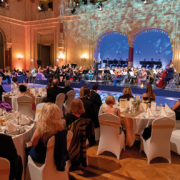
ARANYBÁL (BALL OF THE GOLDEN AGE) is a traditional event of Budafok Dohnányi Orchestra, where quality music, a wonderful location and the opportunity to dance to live classical music await all those who wish to attend. This classical ball in a modern gown invites our guests to the elegant building of the Pesti Vigadó, with its sumptuous interior.

BDO offers an opening concert, an opening dance, chamber music performed by various formations, gifts and a delicious dinner. In addition, there will be an exciting quiz game, a ‘spiritual corner’, a raffle and Cultu-Roulette. As the staple highlight of the ARANYBÁL, the BDO Big Band will also take the stage during the evening.

And as for something completely different and unprecedented – the host of the ball and quiz show will be: GÁBOR HOLLERUNG.

For further information, please visit the website of the event: http://aranybal.hu/

LET THE NATION SING 2022

Every year, hundreds of choir singers from all over the country and even beyond our borders gather to sing some of the most significant works of music literature under the direction of Gábor Hollerung, after months of preparation and an intensive rehearsal weekend together. This initiative is driven by a passion for singing, which is so important in the life of amateur choirs that it was even possible to make it happen last year.

This time, the 400 or so singers will be performing Mendelssohn‘s oratorio Elijah, a worthy continuation of and successor to the great Baroque oratorios. It is characterised by an extraordinary richness of melody, exciting dramaturgy and huge, operatic choral tableaus. The concert promises to be a feast for the audience and the performers alike.