BUDAFOK CONCERT NIGHTS 2023-24/6

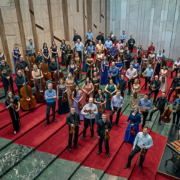
Budafok Dohnányi Orchestra has prepared a real spring programme to usher in the season.

The first piece is Debussy’s Petite Suite, composed between 1886 and 1889. The work was originally written for piano four hands, but was rewritten several times, and an orchestral version was composed in 1907. The Petite Suite is one of Debussy’s early works, written before the composer’s Impressionist period, and therefore still shows the influence of his contemporaries, the characteristics of the French Romantic school, including simple structure and sensuous harmonies. The first two movements of the four-movement work, En bateau (Sailing) and Cortège (Retinue), are linked to Verlaine‘s poems, while the second two movements, Menuet and Ballet, draw the listener in with their dance-like character.

It is well known that BDO is keen on playing and promoting works by contemporary Hungarian composers. Tonight’s concert will feature a performance of the Saxophone Concerto by conductor Kornél Thomas. The work was composed in 2022 with the aim of expanding the classical saxophone repertoire. As he is very interested in mixing different genres, he considered the saxophone to be a perfect instrument for this purpose. While listening to the work, you will surely discover American minimalism, Bartók-inspired harmonies, passages reminiscent of film music, grunge-rock and funk-jazz influences.

Schumann’s “Spring” Symphony (No. 1) is a true spring-awaiting work, written during perhaps the happiest period of the composer’s life. The youthful momentum of spring was also evident in the work’s genesis, as he sketched the entire symphony in four days and had the score ready a month later. The title was given to the work by Schumann himself, inspired by the last line of a poem by Adolf Boettger: “O, turn, O turn and change your course / In the valley, Spring blooms forth!” Each movement of the symphony also has its own title: The Beginning of Spring, Evening, Merry Playmates, Spring in Full Bloom. The four movements take us from the gloomy beginnings, when winter and spring are still fighting it out, to the fullness of spring, with its own exuberant joy and optimism. It is not by coincidence that this is one of Schumann’s most beloved and most frequently performed works. The first performance took place immediately after it was written, on 31 March 1841 in Leipzig, where Mendelssohn himself conducted the work.


BUDAFOK CONCERT NIGHTS 2023-24/5

Wagner was reading Gervinus’s book on German national poetry during a holiday in Marienbad in 1845, and it was in this book that he first encountered the work of the master-singers. He was fascinated by their story, and soon conceived the idea of a new opera about the competition between the master-singers. He started writing the libretto himself and composed the overture immediately afterwards. For various reasons, however, he was not able to start writing the rest of the opera until years later, and the work was only premièred in 1862. It was worth the wait, however, as Wagner’s only comic opera was a huge success. The story is set in the 16th century and tells of a competition between master-singers, the protagonist of which is young Walther, who competes to become a master-singer. Tonight’s performance features the overture to the opera.

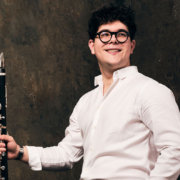
After the overture, we continue our concert with a piano concerto, Ravel’s Piano Concerto in G Major. Ravel began writing this work in the 1930s and initially intended the piece just for himself. Due to technical difficulties that went beyond his piano skills, he finally dedicated the work to pianist Marguerite Long, and eventually it was performed by her at the première. The first and last movements are excerpts from an earlier work: he had originally intended to dedicate a work to his homeland, the Pyrenees, for which he had put sketches on paper. Later he used these sketches in the piano concerto. He had originally intended to call the work “Divertissement”, but changed it to a concerto because of its cheerful, sparkling character. The work will be interpreted by Fülöp Ránki this evening. The young pianist, winner of the Junior Prima Prize, regularly appears as a soloist with leading orchestras and has played with Budafok Dohnányi Orchestra several times, most recently at the Zemplén Festival in 2022.

The second half of the evening will feature Mahler’s Symphony No. 4. This symphony was written for a smaller orchestra during one of the happiest and most successful periods of Mahler’s life, which distinguishes it in character from his other symphonies. He began writing the work in 1899, and it fits in well with his other song symphonies, as the last movement features music composed to the poem Das himmlische Leben, which is performed by a soprano soloist. The title of the poem translates as “Heavenly Life”, showing the abundance of heavenly life through the eyes of a child. The four-movement work is interspersed with serene, joyful images of nature and it concludes with the song.

BUDAFOK CONCERT NIGHTS 2023-24/4

Budafok Dohnányi Orchestra’s traditional New Year concert with lots of surprises and musical sparkles.

BUDAFOK CONCERT NIGHTS 2023-24/3 – CHRISTMAS CONCERT

For their upcoming Christmas concert, the BDO Chamber Music Workshop is preparing a special programme with the Christmas cycle as the central theme. For the first half of the concert, they have put together a medley of musical works linked to Christmas and the spirit of winter by some of the greatest masters of baroque music. The second half of the concert will feature jazz music, often linked to the festive season as it fits in the Christmas spirit rather well, and also some 20th century music that has the capacity of creating an extraordinary atmosphere. The works of Gershwin, Béla Kovács, Ligeti and Rosenblatt will offer the audience a combination of contemplation, exhilaration and musical bravura.

The guest artist of the evening is Dániel Ali Lugosi, who gained national fame in 2014 as the absolute winner of the Virtuosos. He will play a special orchestrated version of Debussy‘s First Rhapsody and Donato Lovreglio‘s highly virtuosic paraphrase of Traviata Fantasia, with themes from Verdi’s opera, of course.

Thanks to the special instrumental arrangement of the BDO Chamber Music Workshop, each piece is given a new, unique instrumentation that embodies both the traditions of chamber music and the grandiosity of large orchestral sound. “The chamber music workshop is, after all, doing exactly what musicians have been doing for centuries, or rather millennia: performing established music according to their own instrument, possibilities and tastes, their audience, horribile dictu their own interests, sometimes with less valuable outcome than the original, but sometimes with an even better resulting performance. Well, the BDO Chamber Music Workshop is doing their utmost to tip the scales towards the latter. Because almost everything they do is fascinating. Apor Szüts is a virtuoso instrumentalist and a virtuoso pianist, but both the transcriptions and the performance are characterised by such lightness and a sense of naturalness that even the boldest (instrumental) changes do not feel far-fetched, and Szüts’ sparkling piano playing does not intrude into the foreground, it simply feels like a peculiarity of the consonance.” (Revizor – the review portal)

BUDAFOK CONCERT NIGHTS 2023-24/2 FILM MUSIC – DIFFERENTLY

Film music – differently: this could be the title of today’s concert, since all works included in the repertoire are in some way connected to the world of movies, whether by their character, their genesis or their composer. William Walton‘s Johannesburg Festival Overture was not written for a film, but its momentum and character make it easy to imagine it as a film score. William Walton is an English composer who was born in the early 1900s and lived through almost the twentieth century. He composed in many genres and styles, from film music to opera. He wrote this work in 1956 at the request of Ernst Fleischmann, the music director of the Johannesburg Festival, to mark the seventieth anniversary of the city’s foundation. Fleischmann had specifically requested that the work should include an African theme or motif, and Walton delivered it through the percussions’ part. He himself described this work as a non-stop, dynamic gallop that requires great attention and technical preparation from the orchestra.

Nino Rota probably needs no introduction to those who have seen the highly successful Godfather trilogy. The film’s catchy melodies also won an Academy Award. But many people may not know that Nino Rota left behind a large body of classical music, and that film music was only one part of his oeuvre. In 1972 he wrote his Cello Concerto No 1, which we will hear tonight. He composed it in a late Romantic style, which requires considerable technical skill from the soloist, and offers an equally prominent role for the orchestra. The cello solo will be played by Domonkos Hartmann, a student of Ditta Rohmann and Dóra Kokas at the Liszt Academy of Music in Budapest and István Várdai in Vienna. He was awarded the Junior Prima Prize in 2022.

Budafok Dohnányi Orchestra is known to be keen to play and promote works by contemporary Hungarian composers. It is in this spirit that BDO gives composers the opportunity to submit a new work every year. One of the works selected for this season is by Levente Kovács, a professionally scored and orchestrated Hollywood-style film music with all the appertaining features.

The concert will conclude with a work by a composer who is regularly featured at the Budafok Dohnányi Orchestra’s film music concerts. Erich Wolfgang Korngold, the ‘Viennese child prodigy’, whose musical talent was evident from an early age, soon attracted the attention of Hollywood. The Sea Hawk is a 1940 adventure film starring Errol Flynn the protagonist of which is an English pirate who tries to defend England’s interests against the Spanish Armada. Korngold was commissioned to compose a rather long piece of music, which ended up being perhaps his most complex film music, and therefore more of a symphonic work than a film score. This evening, the audience will hear a suite version of it.

BUDAFOK CONCERT NIGHTS 2023-24/1

The first Budafok concert night of the 2023-24 season will start with Kaiser Walzer (Emperor Waltz) by Johann Strauss II. The work was inspired by Franz Joseph I’s visit to Emperor Wilhelm II of Germany in 1889. The work is a sort of tribute to this meeting. The title – ‘Emperor Waltz’ – was given by Strauss’s publisher, Fritz Simrock, referring to the two empires involved and to please the two emperors.

The second work of the evening is Bartók’s Two Portraits. He wrote this piece for orchestra and solo violin in 1907-1908. The title suggests that the work depicts two different psychological moments of the same person: the ideal and the distorted. The same motif appears in both portraits, just in different characters. While in the “Ideal” the portrait is represented by the solo violin, in the “Distorted” the portrait unfolds from the melodic fragments of the orchestra. The work was inspired by violinist Stefi Geyer and Bartók’s unfulfilled love for her.

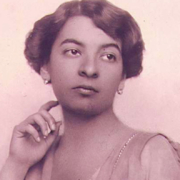
The final piece of the evening is a work by composer, pianist and violinist Dóra Pejácsevich. The composer was born in Budapest in 1885 to a Hungarian mother and a Croatian father. Her mother was also a pianist, so she got immersed in music at an early age. Despite her short life, she left behind a rich oeuvre of 106 works, mostly in the late Romantic style, including songs, piano pieces, chamber works and orchestral works. The Symphony in F-sharp minor, to be performed this evening, was the one that elevated her to the ranks of the most important Croatian composers.

The first concert of the Budafok Concert Nights series features Croatian conductor Mladen Tarbuk at the helm of Budafok Dohnányi Orchestra. He has visited Hungary many times and regularly conducts works by Hungarian composers. In addition to his conducting activity, he is also a composer, having written some ninety works of music.

GAMER SYMPHONY – Game Music Show

For this concert show, a 30% discount is available as part of the Budafok Dohnányi Orchestra’s spring promotion. The coupon code for the discount is GAMERTAVASZ, which can be validated by entering it in the coupon code field during the checkout process. The discount is automatically deducted from the total value of the cart before payment.

GAME MUSIC SHOW – finally in Hungary!

Budafok Dohnányi Orchestra’s spectacular Game Music Show will feature music from the most popular, iconic video games, dance and fascinating visuals for gamers and audiences open to exciting symphonic music.

The spectacular concert show will feature some of the most popular and now iconic early video game music, as well as music from today’s iconic games, with an amazing visual and dance performance reminiscent of the original video games.

Although video game music has been a very popular concert theme in Japan for decades, it is only now making its way to Hungary, courtesy of Budafok Dohnányi Orchestra and Gábor Hollerung.

You can enter our GAME related to the concert and win free tickets here: https://bdz.hu/gamer-symphony-nyeremenyjatek/

The Sceptical Spirit

The two compositions on the programme of the Budafok Dohnanyi Orchestra concern themselves with the ways of the world; Richard Strauss turned to Nietzsche’s epochal work for inspiration, while Levente Gyöngyösi chose a national classic, Imre Madách’s piece. The latter is an award-winning piece of Müpa Budapest’s Composition Competiton 2020, which will have its world premiere now. The first of the planned four parts of Tragœdia Temporis, a large-scale staged oratorio, it deals with the creation, Adam and Eve’s life in Paradise and their expulsion from Eden.

The work, whose libretto was written by Judit Ágnes Kiss based on the concept of Levente Gyöngyösi and András Visky, features a very important character who cannot be found in Madách’s drama: a child, an angelic person, who was already by the Lord’s side before Creation. “The Lord brought me forth as the first of his works, before his deeds of old,” reads the Book of Proverbs. “I was formed long ages ago, at the very beginning, when the world came to be.” Later it is said: “Then I was constantly at his side. I was filled with delight day after day, rejoicing always in his presence.” In Madách, the magnum opus has been finished when the play starts, while in this oratorio “the world comes to be as the prologue of the work, in the witnessing presence of the viewer, by the acquisition of language by the Child,” András Visky said.

18. BUDAPESTI NEMZETKÖZI KÓRUSVERSENY – ZÁRÓHANGVERSENY

A Budapesti Nemzetközi Kórusverseny nagyközönség számára legizgalmasabb eseménye a zárókoncert, melyen a kategóriák legjobb énekkarai mérik össze tudásukat a nagydíjért.
A nagydíjas verseny után Carl Orff népszerű Carmina Buranája szólal meg a Budapesti Akadémiai Kórustársaság közreműködésével.

Carmina Buranát a kórusirodalom legnépszerűbb alkotásai között tartják számon, nem véletlenül: Dallamai a szívig hatolnak, a múlt álmába repítenek. Időtlen zene, amely megragadja a változó világot. Orff zenéjének legjellemzőbb sajátossága a primitív dallamkészlet, az erőteljes dinamika és a motívumok mágikus ismétlődése – ezek pedig az ősi törzsi énekek dobbal kísért lüktetését, kábító varázsát, ösztönös és erotikus szenvedélyét idézik. A Carmina Buranának nincs története, a világot mozgató erőt, az életörömöt állítja a középpontba. A mű a szerelemről, a kikeletről, az ifjúságról, a természet megújulásának élményéről szól.

PASSIONE ALL’UNGHERESE

To celebrate the 30th anniversary of the orchestra, BDO will be giving a concert in Vienna, too. The aim of its programme is to present the passionate, virtuoso face of Hungarian music.

The first piece to be performed is the first movement of Levente Gyöngyösi’s Symphony No. 1. Gyöngyösi is an outstanding figure of the young generation of Hungarian composers, and his work captures the emotional diversity of love. The composer’s musical language is a mixture of classical musical thought, jazzy rhythms and the elemental nature of folklore.

Liszt’s Hungarian Fantasy is a composition of folk melodies, verbunk music and dances propagated by Hungarian gypsy musicians, complete with a vibrantly virtuosic piano solo. The soloist of the piece is János Balázs, a Hungarian pianist widely considered as the successor of the legendary György Cziffra, a worthy continuator of the Cziffra tradition not only for his phenomenal technique but also for his improvisational skills.

Bartók’s Dance Suite was written for the 50th anniversary of the unification of Pest-Buda and Óbuda (Old Buda). The work is about the common destiny of humanity. The composer combines the treasures of folk music of six nations with an impressive folk dance finale that is so characteristic of his art. With profound faith, Bartók sends a message to posterity that there is much more that unites us than what divides us.

Zoltán Kodály’s work Dances of Galánta is the result of a folk music collecting trip he made to Felvidék (or “Upper Hungary”, the area that was historically the northern part of the Kingdom of Hungary, mostly belonging to Slovakia in our days – the tr.). The work features the best of Hungarian music: verbunk music, jumping dances, bagpipe dances, and finally a clarinet solo evoking the tipsy man’s humming, followed by a drifting, whirling, truly Hungarian dance. The interesting thing about the performance is that before the start of each musical material of the piece, a “band” of musicians formed by the members of the orchestra will perform the original music, just as Kodály had probably heard it from the gypsy musicians of his childhood.